

There’s this magical moment that happens when kids step outside—suddenly the smallest thing becomes the biggest adventure. A wooden plank becomes a bridge, a tree stump becomes a rocket, and a little pile of leaves turns into something very important, usually involving pretend soup. And honestly, watching kids play like this always makes me think, “Why don’t adults get outdoor sensory walls too?” Maybe we’d all be less stressed.
But the truth is, creating an outdoor learning and play space can feel overwhelming. You scroll Pinterest, your brain goes, “Yes, this is adorable!” and then immediately, “Wait… how do I even build that?” And suddenly you’re deep in research about natural playscapes, woodland backyard landscaping, and DIY outdoor kids backyard ideas—while your kid is asking if they can use your broom as a pretend horse.
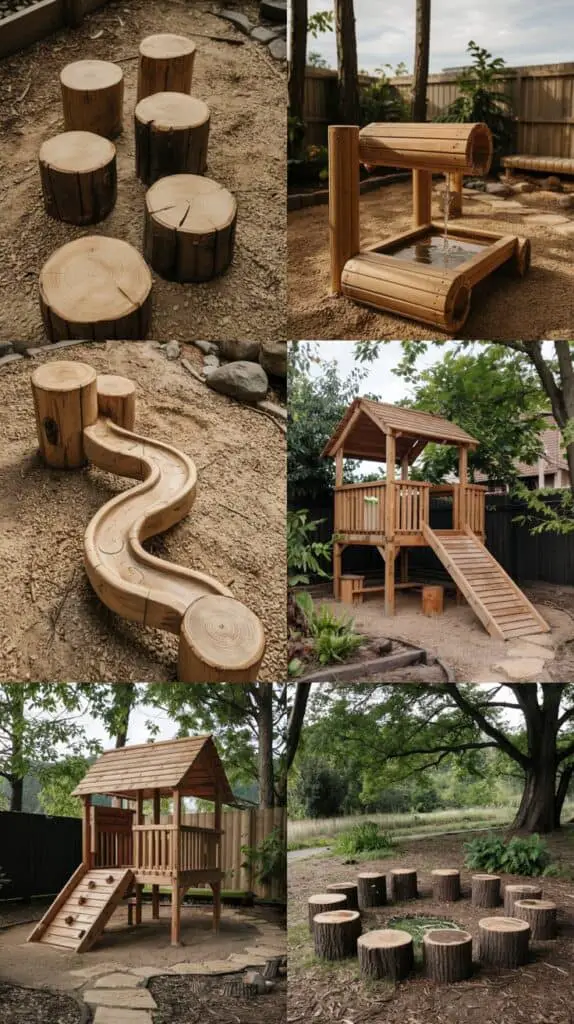
The good news: wooden play spaces don’t have to be complicated or expensive. With a few down-to-earth ideas, you can turn a school backyard, small garden play area, or regular family yard into something that feels calming, creative, and kind of magical, without needing a whole construction crew. These spaces invite kids to explore, learn, climb, balance, and get messy (in the good way), all while being surrounded by nature.
So here are some inspiring ideas to help you build an outdoor children’s play area that actually works in real life—simple, wooden, nature-focused, and filled with sensory fun.
Woodland Timber Trail: A Simple Outdoor Play Area That Invites Adventure

Imagine stepping into your backyard and seeing a wooden balance trail winding between trees, stumps, and patches of soft groundcover. This is the heart of a natural outdoor play space—simple shapes, warm materials, and a sense of “choose your own adventure” built right in.
A woodland timber trail works beautifully in both small garden play areas or larger school outdoor areas. Start with a few chunky wooden stumps in different heights (think 10–40cm), spaced just far enough apart so kids feel brave but safe. Add a few log balance beams—straight or curved—and maybe one wobbly plank on low posts for extra challenge. Kids naturally test their balance, coordination, and courage without realising they’re practicing outdoor learning skills.
To expand it, scatter sensory stepping rounds filled with textures: bark, smooth stones, pinecones, sand, or wood slices. This nods to Waldorf-inspired natural play and makes every step feel a little different. Frame the whole trail with native shrubs, small trees, or even tall grasses for that woodland backyard landscaping feel.
It’s low-cost, beautiful in every season, and irresistible to kids—especially when you subtly call it “the adventure trail.” Oh yes, they will run straight to it.
The Wooden Sensory Wall: A Nature-Inspired Learning Station Kids Can’t Resist
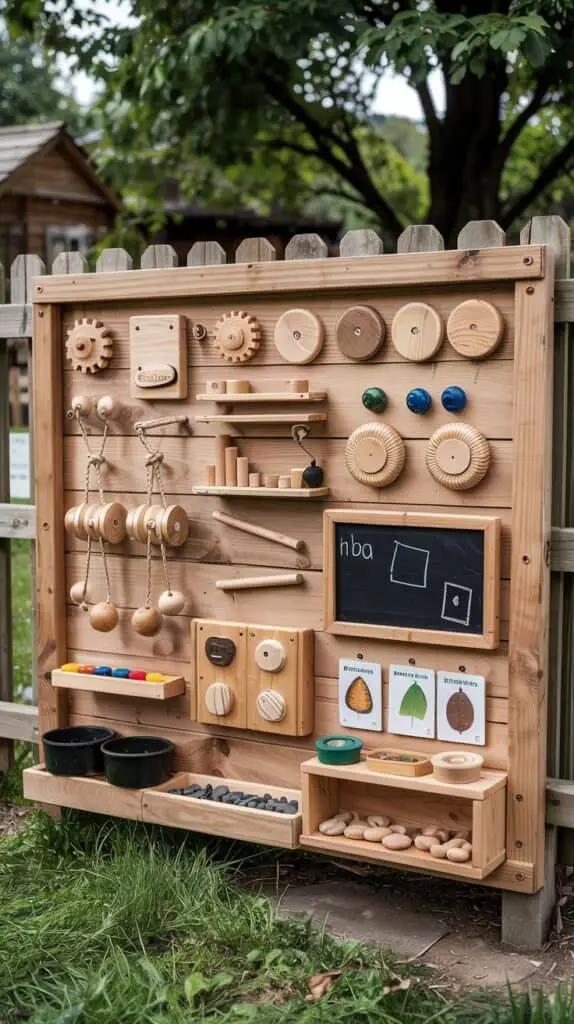
Outdoor sensory walls are honestly one of the easiest wins for any backyard playground or preschool outdoor area. They encourage kids to touch, twist, tap, spin, and explore without needing constant instructions. And the wooden version? It’s gorgeous.
Picture a long horizontal wooden panel fixed to a fence or two sturdy posts. Now fill it with sensory elements made from natural materials: wooden gears, sliding blocks, rope pulleys, bamboo tubes for dropping pebbles through, pots and pans for sound, textured tiles, mini chalkboards, little flip-open doors that reveal pictures of leaves, nuts, bugs—anything closely connected to your local environment.
This becomes a mini outdoor learning lab. Kids experiment with sound, cause-and-effect, comparison, patterns, and textures—all through play.
For schools, you can divide the wall into zones: a math zone with wooden counting beads, a nature ID zone with wooden discs showing leaf shapes, or a sound zone with natural percussion. For backyard families, you can keep it simple and let the kids add their own “finds” from around the garden.
Add a little wooden roof or an overhead shade cloth so kids can use it all year. It quickly becomes the busiest corner of the outdoor children’s play area—trust me, they’ll never walk past it without touching something.
The Log & Loose-Parts Construction Yard: Endless DIY Outdoor Kids Backyard Ideas
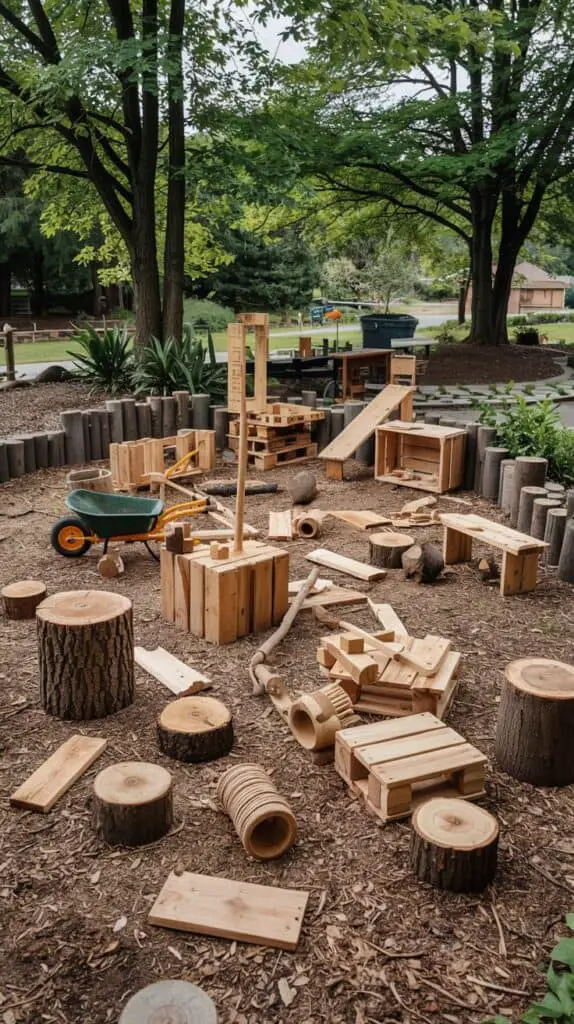
If you’ve ever seen a child handed a pile of wooden blocks outdoors, you know what happens: total architectural chaos. But in the best way. A loose-parts construction yard gives kids the freedom to build, knock down, rebuild, and experiment using natural materials that feel real and tactile.
Start with a base of mulch, bark chips, or compacted earth. Add a low wooden edging to define the “construction zone” so it feels intentional. Then bring in the good stuff: thick log slices for stacking, short planks for ramps and bridges, smooth wooden blocks, bamboo tubes, tree branches, and a few crates or pallets.
This kind of natural playscape encourages STEM thinking—kids naturally test weight, height, balance, friction, and structure (even if they don’t realise they’re basically junior engineers). Schools often add small wheelbarrows, buckets, and rope for hauling materials. In backyards, parents usually add a rule like “build it as tall as your knee” to keep things safe but still fun.
Every day the space looks different because kids shape it themselves. And honestly, it’s amazing to see how creative they get when the materials are simple and natural.
The Wooden Mud Kitchen Garden: Outdoor Learning Through Playful Cooking
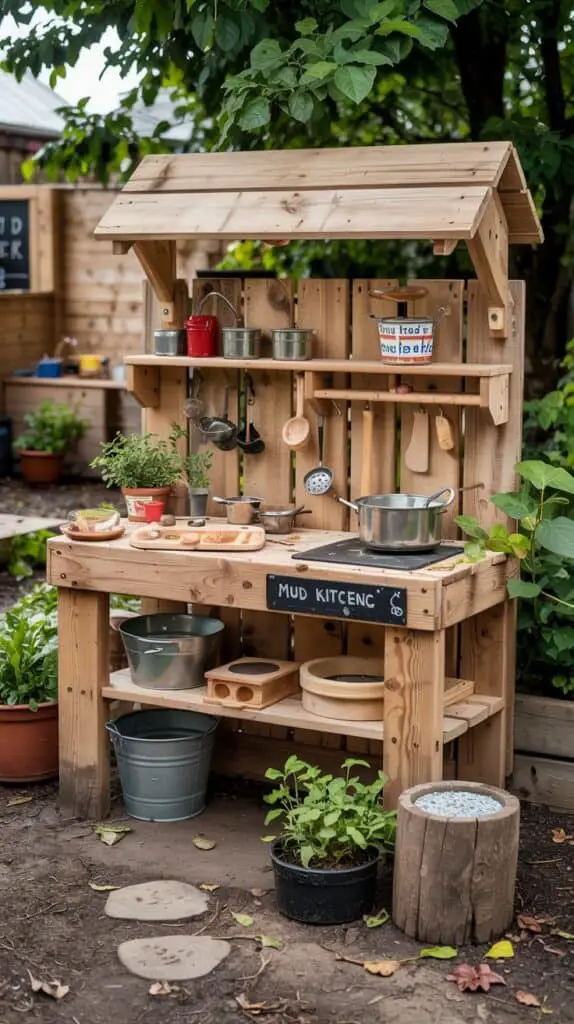
Mud kitchens are practically childhood gold. They’re messy, imaginative, sensory-rich, and surprisingly calming. And when built with wood and tucked into a leafy corner, they look like a tiny outdoor café run by children who accept leaves as currency.
To build one, start with a wooden counter made from a repurposed pallet or simple timber boards. Add shelves, hooks, and a “sink” (an old metal bowl is perfect). A wooden roof or pergola gives it that cute cottage-play feel. Fill it with metal pots, little ladles, wooden spoons, old muffin trays, and recycled jars.
Now the magic: place the whole setup beside a “mud garden.” Add a soil patch, herb pots they can pick from, a water butt or bucket, a gravel bowl for rinsing, and a few stumps for seating. Suddenly you’ve got an outdoor school space or backyard play area where kids mix, stir, pour, collect, observe, and basically do science in disguise.
It’s great for group play, storytelling, teamwork, and sensory exploration. Plus, you’ll hear a lot of “Would you like a cup of leaf tea?” which is honestly adorable—until they hand you a cup that looks suspiciously like real soup.
The Tree-Stump Classroom Circle: A Calm Outdoor School Space for Learning & Stories
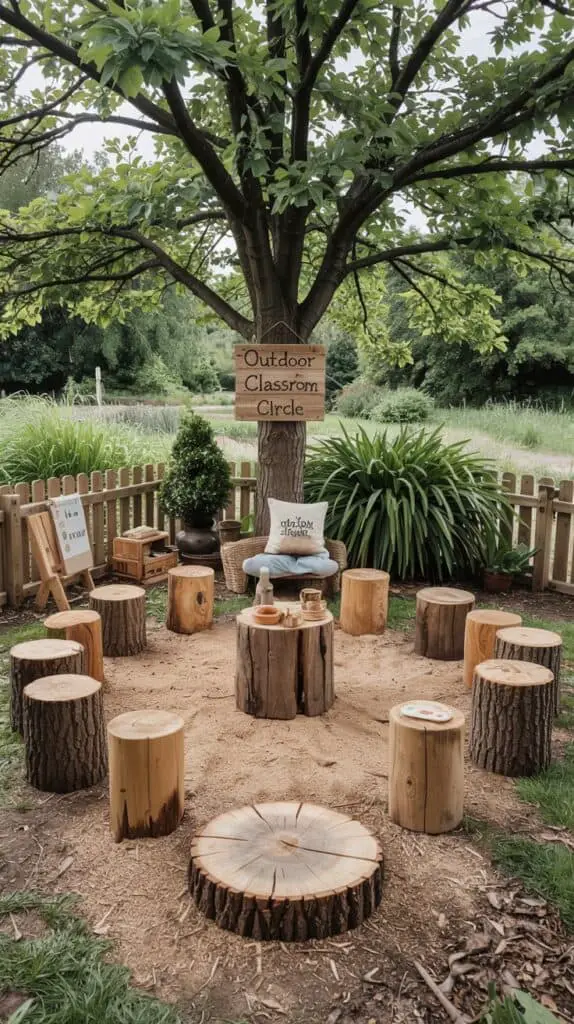
Every backyard or school outdoor area needs at least one quiet, grounding zone—and a wooden stump circle is one of the most charming and practical options.
Imagine a soft clearing under a tree, or a sunny corner of your yard. Set out a ring of evenly sized wooden stumps, leaving space for movement but keeping the circle close enough to feel cozy. In schools, you can size it for a full class; in homes, five or six stumps is perfect. Add a larger central stump for storytelling, nature demonstrations, or little group activities.
To elevate it, surround the circle with low wooden fences, native shrubs, or tall grasses to create a sense of enclosure. A small wooden sign reading “Outdoor Classroom” or “Wonder Circle” can transform the mood instantly. Teachers often use it for nature reading sessions, outdoor maths, or science observations. Parents use it for snack time, crafts, or simple meditation moments with kids.
It’s peaceful, grounding, and invites children to slow down—something we all secretly need as much as they do.
The Wooden Climbing Fort: A Simple Backyard Play Area for Kids Who Love to Explore
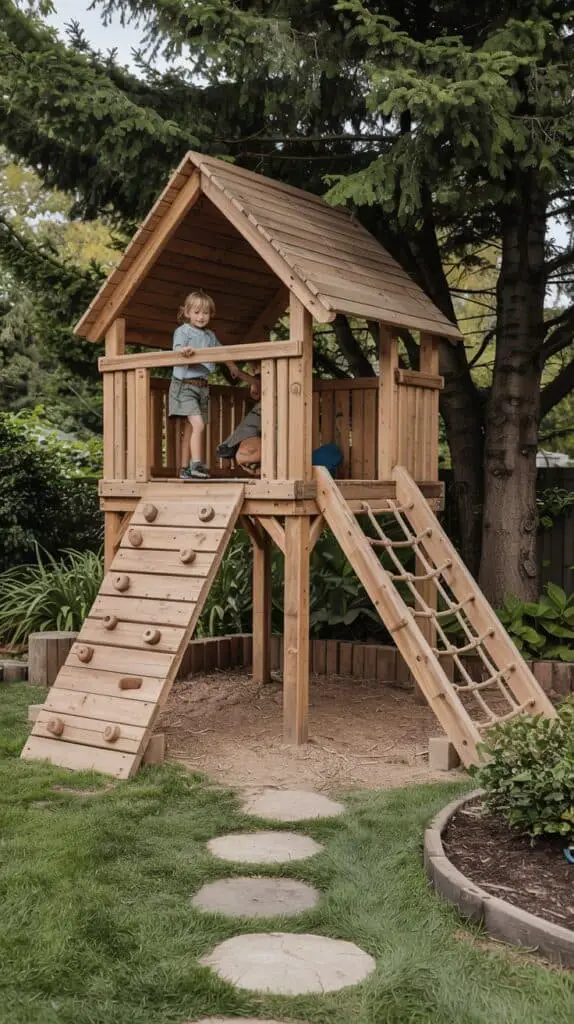
Every kid deserves something to climb. Not a huge playground tower with fifty slides—just a simple wooden fort that feels like their place. A climbing fort can be as small as a platform with a rope ladder, or as detailed as a mini two-level hideout tucked behind a tree. What matters is the sense of ownership and adventure.
Picture a sturdy wooden platform raised just high enough to feel exciting but still safe. Add a climbing wall with chunky wooden grips, a rope net on one side, and a little slide or balance plank on the other. Schools sometimes expand this into a natural outdoor play space by adding a lookout rail, a flagpole made of smooth bamboo, or even a wooden periscope. In backyards, you can keep it more minimal—kids honestly fill the space with imagination way faster than adults ever could.
Surround it with soft mulch or grass, maybe even a ring of log stepping stones leading up to the structure. When you tuck the fort among shrubs, low trees, or tall grasses, it almost feels like a tiny woodland outpost. Kids climb, sit, read, spy on imaginary creatures, and build secret missions. It becomes the “base” for everything.
And yes, adults end up sitting on it too, usually saying “just testing if it’s stable,” but we all know you’re enjoying it a little bit.
The Bamboo Water Run: A Nature-Inspired STEM Play Zone
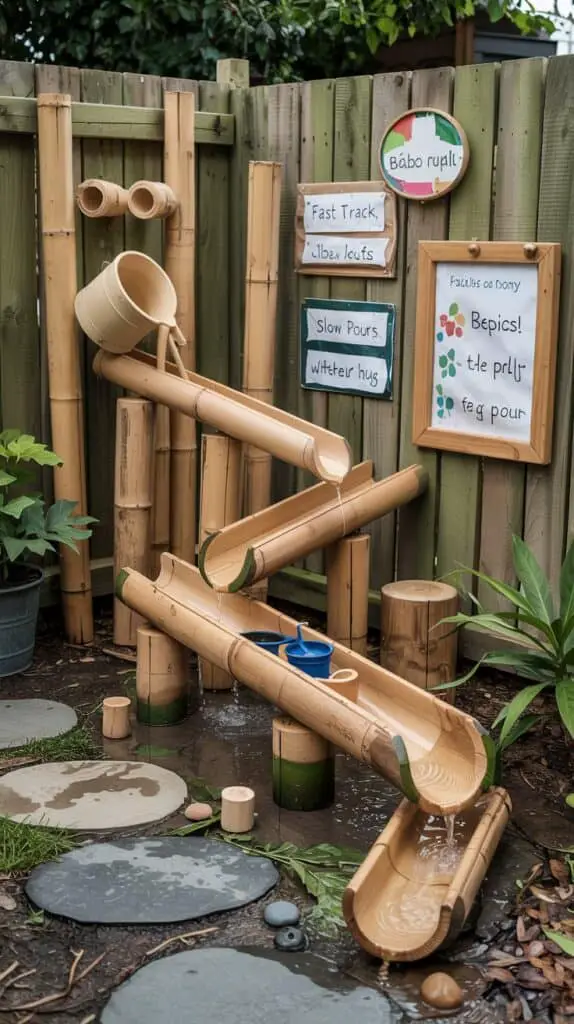
If you need an idea that works for tiny backyards, school outdoor areas, or preschool corners with limited space, this is it: a bamboo water run. It’s visually beautiful, ridiculously fun, and actually teaches kids early physics without them realising.
Start with vertical wooden posts or a fence panel. Then attach different lengths of split bamboo channels at various angles—some straight, some zig-zag, some that drop into buckets, some that loop back around. Add wooden funnels, corks, pebbles, little scoops, and a big water jug so kids can pour, splash, test and predict where the water will go.
The sound alone is super calming—like a tiny natural waterfall. In a school setting, teachers label zones like “fast track,” “slow route,” and “waterfall corner,” which sneaks in vocabulary and science skills. In a backyard, you can simply stand back and enjoy watching them experiment: more water, less water, higher angle, lower angle, splash zone, dry zone, and so on.
Place some stepping stones or small wooden decking under the water run so you don’t end up with accidental mud bath days… unless your kids love mud. Then lean into it. Mud is basically free entertainment.
The Nature-Based Sandpit Pavilion: Calm, Creative, and Kind of Magical
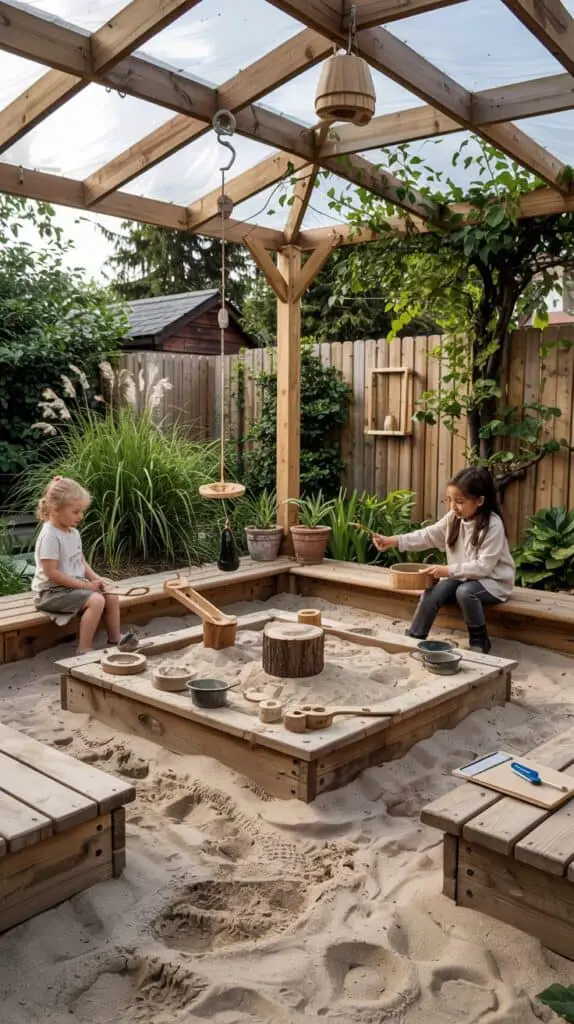
There is something about a wooden sandpit that feels timeless. Maybe it’s because every generation has played in one, or maybe it’s because sand really is the perfect open-ended material for kids. But adding a small wooden pavilion roof above it? That transforms it from “backyard sandbox” to “tiny nature studio.”
Picture a square or circular wooden sandpit with built-in seating edges. Above it sits a simple pergola-style frame with beams that let sunlight filter softly through. You can grow climbing plants over it, hang wind chimes, or add a wooden pulley system for lifting small buckets of sand.
Fill the sandpit with metal scoops, little wooden molds, natural hand tools, shells, stones, and maybe a row of wooden pots where kids can store their “creations.” In a school outdoor area, teachers place clipboards or mini chalkboards nearby for kids to sketch what they build. In smaller gardens, you can keep it cozy by planting tall grasses or bamboo around the edges so the space feels like a hideaway.
Kids will sit here for ages, shaping landscapes, digging tunnels, or building entire sand cities. And honestly, there’s something calming for adults too when you sit nearby, listening to the soft sound of shovels and giggles.
The Small Garden Discovery Pathway: A Learning Walk for Tiny Spaces
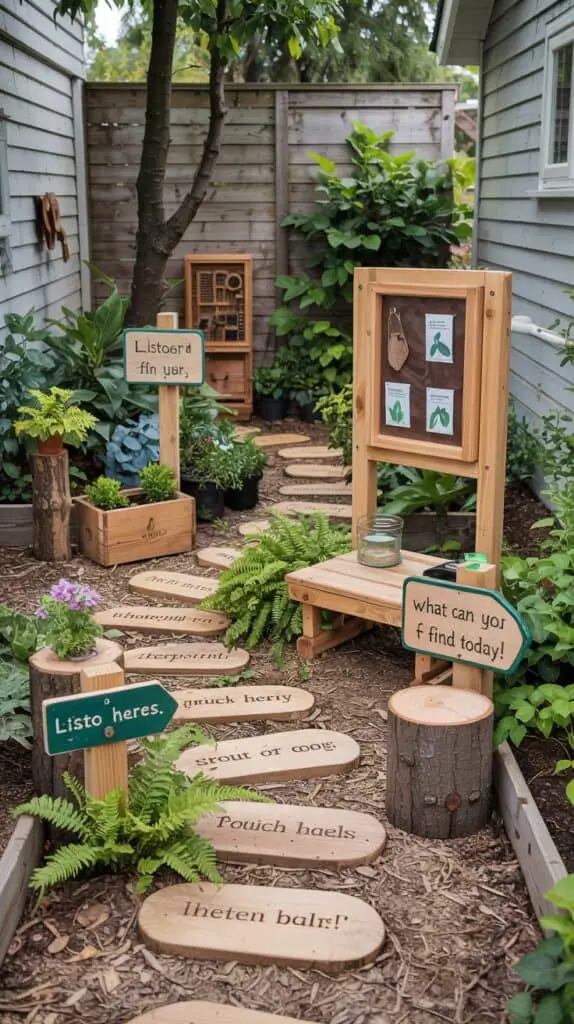
If you have a small backyard—or a narrow school yard that feels impossible to design—this idea fits perfectly. A wooden stepping pathway becomes a playful “learning walk” that guides kids through mini zones of exploration.
Start with simple wooden stepping discs or flat log slices placed in a winding path. Between them, tuck small learning stations: a mini planter box with herbs to smell, a bug hotel made from bamboo tubes, a wooden frame with leaf ID cards, a small outdoor sensory wall panel, and even a tiny wooden bench where they can stop and observe.
Because it’s a pathway, it works brilliantly in long, thin yards. Add little signs like “listen here,” “touch this,” or “what can you find today?” and suddenly kids walk slowly and intentionally. This is great for preschool outdoor areas or nature-based backyard play for kids who like quieter activities.
You can soften the whole space with bark mulch, ferns, native shrubs, or a few tree stumps positioned at slight angles. A discovery pathway isn’t about big play—it’s about gentle exploration, which kids need just as much.
The Outdoor Learning Shed: A Wooden Mini Classroom for All-Weather Play
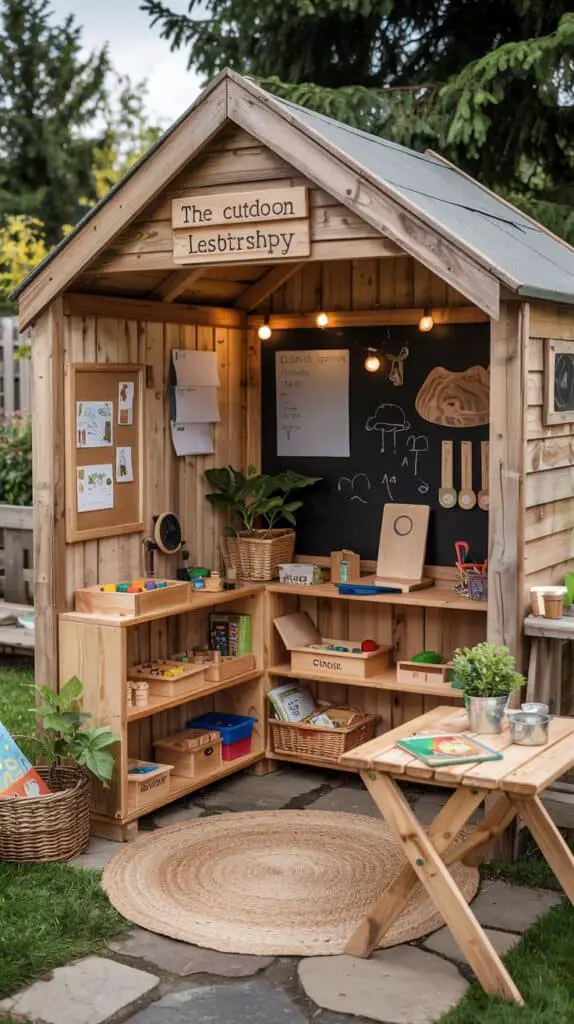
This sounds fancy, but it can be incredibly simple: a small wooden shed or open-sided pavilion where kids gather for creative activities, reading, crafts, or small-group learning.
Inside, include low shelves with baskets of loose parts, wooden blocks, nature items, magnifying glasses, and clipboards. Hang kid-friendly posters inside wooden frames, add a chalkboard wall, and use a natural jute rug on the floor. Keep the colors earthy so it feels like an extension of the garden rather than a storage space.
Schools often build these as extensions of their outdoor school spaces—half classroom, half workshop. Families can create a cozy version with warm fairy lights, a fold-out wooden table, and weatherproof cushions.
The beauty of this idea is that it works year-round. Rainy day? The shed becomes the main hub. Sunny day? Kids grab materials and head outside. It becomes the bridge between indoor learning and outdoor play, tying your whole backyard or school outdoor area together.
final thoughts
Designing wooden outdoor play and learning spaces doesn’t need to be overwhelming or expensive. When you work with natural materials—wood, bamboo, logs, plants—the whole area automatically feels calmer, warmer, and more child-friendly. And honestly, kids don’t need a big flashy playground. They need textures, movement, things to climb, places to hide, corners to dig, and simple tools that let them explore freely.
Whether you have a sprawling school backyard or a tiny home garden, these ideas can grow with your kids and shift throughout the seasons. And the best part? You’ll probably find yourself sitting on a stump, running your hand along a wooden beam, or watching water flow through a bamboo run thinking… “Okay wow, this is actually pretty relaxing.”